

Group life insurance imputed income is the taxable value the IRS assigns to employer-paid life insurance coverage above $50,000. Most employees see it on their pay stub as "GTL" and have no idea what it means or why it raises their taxable wages. The concept is straightforward once you know the rules. This guide explains how imputed income is calculated, how it shows up on your W-2, and what it actually costs you at tax time, whether you are an employee trying to make sense of your paycheck or an HR professional managing payroll compliance.
What is group life insurance imputed income?
Group life insurance imputed income is defined as the taxable benefit employees receive when their employer provides life insurance coverage exceeding $50,000. The IRS requires employers to treat the cost of that excess coverage as income, even though the employee never receives cash. Coverage over $50,000 is taxable imputed income under IRS rules.
The term "imputed" simply means assigned or attributed. The IRS assigns a dollar value to the non-cash benefit you receive, then adds that value to your gross income. You pay tax on it just like you would on a regular paycheck, even though no money changes hands.
Group life insurance is typically offered as part of an employer benefits package, requires no medical exam, and costs employees little or nothing in direct premiums. That accessibility makes it a genuinely valuable benefit. The imputed income rule simply ensures the IRS captures tax on the portion of that benefit that exceeds the $50,000 exemption.

How is imputed income from group life insurance calculated?
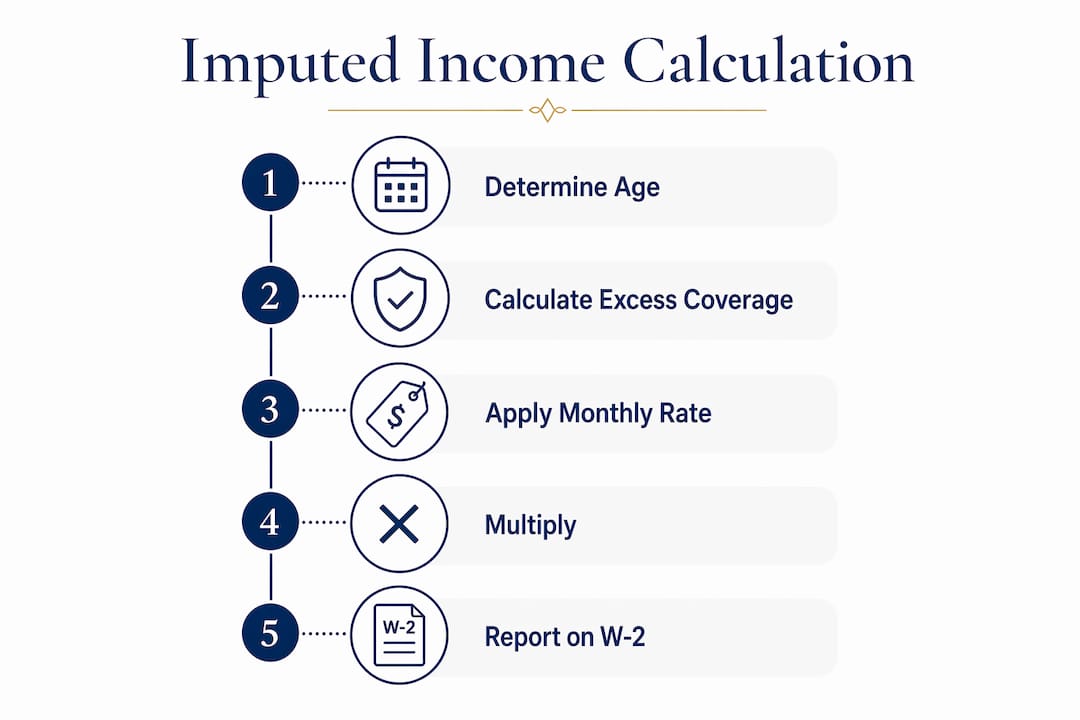
The IRS uses a standardized tool called Table I, also known as the Uniform Premium Table, to calculate imputed income. IRS Table I assigns rates by five-year age brackets, expressed as a monthly cost per $1,000 of coverage. The table rate, not the actual premium your employer pays, determines your taxable amount.
The formula employers use is: Monthly Rate × (Coverage Amount Over $50,000 ÷ $1,000). For example, if you are 47 years old and your employer provides $150,000 in coverage, the taxable portion is $100,000. At the IRS Table I rate for ages 45–49, that calculation produces a monthly imputed income figure that gets added to your taxable wages.
The table below shows representative IRS Table I rates by age bracket:
| Age bracket | Monthly rate per $1,000 of coverage |
|---|---|
| Under 25 | $0.05 |
| 25–29 | $0.06 |
| 30–34 | $0.08 |
| 35–39 | $0.09 |
| 40–44 | $0.10 |
| 45–49 | $0.15 |
| 50–54 | $0.23 |
| 55–59 | $0.43 |
| 60–64 | $0.66 |
| 65–69 | $1.27 |
| 70 and above | $2.06 |
Rates increase sharply with age. A 58-year-old with $200,000 in employer-paid coverage faces a meaningfully higher imputed income figure than a 32-year-old with the same coverage. That age sensitivity is why two employees at the same salary can have very different tax exposures from the same benefit.
Employers calculate this monthly and the result appears on pay stubs, typically labeled "GTL" for Group Term Life. The amount accumulates across the year and shows up on your W-2 at tax time.
Pro Tip: Check your pay stub for a line labeled "GTL" or "Imputed Inc." If the dollar amount looks wrong, ask HR to walk through the Table I calculation using your age and coverage amount. Errors in the age bracket used are the most common source of miscalculations.
How does imputed income affect W-2 reporting and payroll?
Imputed income changes how your wages are reported on your W-2 in two specific places. Employers must include imputed income in Box 1 (wages, tips, and other compensation) and report it separately in Box 12 using Code "C." That Box 12 entry is informational. It tells the IRS the amount of taxable group term life insurance included in your wages.
The payroll tax treatment has one important nuance. Imputed income is subject to FICA taxes, meaning Social Security and Medicare taxes apply. Federal income tax withholding, however, is typically not required on imputed income. That distinction matters for payroll teams because it affects how withholding is set up in payroll software.
Here is what HR professionals should communicate clearly to employees:
- Imputed income is an addition to taxable wages, not a deduction from your paycheck.
- The GTL line on your pay stub shows a taxable earnings increase, not money being taken out.
- Your FICA taxes will be slightly higher because of the added taxable wages.
- Federal income tax is generally not withheld on imputed income during the year, but it will affect your annual tax liability.
- Box 12 Code "C" on your W-2 is not an error. It is a required IRS disclosure.
Employees commonly misinterpret GTL imputed income as a paycheck deduction rather than taxable earnings. HR teams that address this proactively during open enrollment or onboarding reduce confusion and payroll-related support tickets significantly.
Pro Tip: HR professionals should include a one-page imputed income explainer in annual benefits communications. A simple example using a $100,000 coverage scenario and the employee's age bracket prevents most of the "why is my paycheck wrong?" questions that spike every january.
What does imputed income actually cost employees?
The real-world tax cost of imputed income is modest for most employees. Imputed income typically adds $100 to $400 annually to taxable wages, resulting in an additional $25 to $120 in taxes per year. For a 45-year-old, the annual taxable income increase often lands in the $120 to $180 range.
The actual cost depends on three variables: your age, your coverage amount, and your marginal tax rate. Older employees with high coverage multiples tied to salary face the largest imputed income figures. A 60-year-old earning $120,000 with two times salary in coverage ($240,000 total) will see a noticeably higher imputed income than a 35-year-old at the same salary.
Here are four tax planning steps employees can take:
- Calculate your annual imputed income. Multiply your monthly GTL amount by 12. Compare that number to your actual W-2 Box 1 wages to confirm accuracy.
- Adjust your W-4 withholding if needed. Because federal income tax is not withheld on imputed income during the year, some employees owe a small amount at filing. Increasing your withholding by one allowance can offset this.
- Compare the benefit to individual life insurance costs. Group coverage at no direct cost to you, even with the small tax on the excess, is almost always cheaper than buying equivalent individual term coverage on your own.
- Consult a tax advisor if your coverage exceeds $200,000. At high coverage levels, especially for senior employees, imputed income can add several hundred dollars to your annual tax bill. A tax professional can help you model the exact impact.
The core takeaway is that imputed income is a small price for a valuable benefit. Most employees pay less in additional taxes than they would spend on a comparable individual policy in a single month.
Common misconceptions about group life insurance imputed income
The most persistent misconception is that imputed income is calculated from what your employer actually pays in premiums. The IRS uses standardized Table I rates, not actual premium costs, to determine taxable imputed income. Your employer might negotiate a group rate far below the IRS table rate, or above it. The IRS calculation ignores that entirely.
Several other misunderstandings trip up both employees and HR teams:
- The $50,000 threshold is fixed. The exemption has not been adjusted for inflation since it was established. That means employees whose coverage grows with salary increases face rising imputed income over time, even without any change to their benefit structure.
- Imputed income does not reduce your net pay. It increases taxable wages without reducing the cash you take home. The only effect on your paycheck is a small increase in FICA withholding.
- Salary increases can trigger higher imputed income. If your coverage is set at a multiple of salary, a raise pushes total coverage higher. Once coverage crosses a new Table I threshold, your imputed income rises accordingly.
- GTL on your pay stub is not a mistake. Many employees contact HR convinced there is a payroll error. The GTL line is a required IRS reporting item, not an administrative glitch.
Because the $50,000 exemption is not inflation-adjusted, long-tenured employees with salary-linked coverage face growing tax exposure over their careers. HR teams should flag this during annual benefits reviews, particularly for employees approaching retirement age.
Key Takeaways
Group life insurance imputed income is a small but real tax obligation that every employee with employer-paid coverage above $50,000 should understand and account for in their annual tax planning.
| Point | Details |
|---|---|
| IRS $50,000 threshold | Coverage above $50,000 is taxable; the exemption has never been adjusted for inflation. |
| Table I calculation | Imputed income uses IRS age-based rates, not actual employer premiums, to set taxable value. |
| W-2 reporting | Imputed income appears in Box 1 and Box 12 Code "C" on your annual W-2. |
| FICA applies | Social Security and Medicare taxes apply to imputed income; federal withholding typically does not. |
| Real tax cost | Most employees pay $25 to $120 more per year in taxes because of imputed income. |
What I have learned from years of explaining imputed income to employees
Most employees see "GTL" on their pay stub and assume something is wrong. I have had this conversation hundreds of times, and the confusion is always the same: people think money is being taken from them, when the opposite is true. Their employer is giving them a valuable benefit, and the IRS is simply requiring a small tax on the portion above $50,000.
The part that surprises people most is that the tax calculation has nothing to do with what the employer actually pays. The IRS uses its own table, and that table can produce a taxable figure that looks completely disconnected from reality. That is by design. It simplifies compliance. But it creates a communication gap that HR teams rarely close well enough.
My honest recommendation for HR professionals: do not wait for employees to ask. Build a one-page explainer into your onboarding packet and your annual open enrollment materials. Show a real example using your most common coverage tier and the median employee age. When employees see the math, they stop worrying. A $75 annual tax increase on a $150,000 life insurance benefit is not a burden. It is a bargain.
For employees, the best move is to verify your coverage amount, run the Table I calculation for your age, and check that your W-2 Box 12 Code "C" matches. If you are over 55 with high coverage, talk to a tax advisor. The numbers are still manageable, but they are worth knowing precisely.
Group coverage is almost always the most cost-effective life insurance available to working adults. The imputed income tax is a minor footnote to a genuinely strong benefit.
— Shereka
Life insurance planning made clearer with Familyguardlh
Understanding imputed income is one piece of a larger financial picture. Group life insurance through your employer is a strong foundation, but it rarely provides enough coverage on its own, and it disappears when you change jobs.

Familyguardlh works with employees and families across 22 states to build life insurance strategies that go beyond what a group policy provides. Whether you need individual term coverage to supplement your employer plan, or you are thinking about permanent life insurance as part of a longer-term financial plan, Familyguardlh can help you evaluate your options clearly. Licensed in AZ, CO, FL, GA, IN, MA, MD, MI, NC, OH, PA, SC, TN, TX, VA, and more, Familyguardlh brings straightforward guidance to every conversation. Reach out to see what coverage makes sense for your situation.
FAQ
What is imputed income on a group life insurance policy?
Imputed income is the taxable value the IRS assigns to employer-paid group life insurance coverage above $50,000. It is added to your gross wages even though you receive no cash payment.
How does the IRS calculate group life insurance imputed income?
The IRS uses Table I, a uniform premium table with rates based on five-year age brackets, to calculate monthly imputed income. The formula is: Monthly Rate × (Coverage Over $50,000 ÷ $1,000).
Where does imputed income appear on my W-2?
Imputed income is included in Box 1 (total wages) and reported separately in Box 12 using Code "C." Both entries are required by IRS regulations.
Does imputed income reduce my take-home pay?
No. Imputed income increases your taxable wages but does not reduce the cash in your paycheck. The only direct paycheck effect is a small increase in FICA tax withholding.
How much extra tax will I pay because of imputed income?
For most employees, imputed income adds $25 to $120 per year in additional taxes. The exact amount depends on your age, your coverage amount above $50,000, and your marginal tax rate.