

Public safety and corrections employees who served under PSPRS or CORP earn five months of cancer insurance coverage for every year of credited service, at no cost, extending into retirement. Coverage duration grows with years of service, providing multiple years of coverage after retirement. That is a meaningful financial buffer against cancer treatment costs that can run well into six figures, and it kicks in before Medicare is even an option for most retirees.
Here is what the PSPRS Cancer Insurance Program delivers for eligible members:
- No-cost coverage in retirement earned at five months per credited service year, including DROP years after August 27, 2019
- Lump-sum payments for covered cancer diagnoses to offset immediate financial burden
- Treatment reimbursements for out-of-pocket costs tied to chemotherapy, radiation, and surgery
- Extended paid coverage available after the earned no-cost period ends, for eligible retirees who elect to pay annual premiums
- Supplemental protection designed to work alongside other retirement health insurance and Medicare, not replace it
The program was revised in January 2026, and the updates affect enrollment deadlines, premium billing, and automatic pension deductions beginning in 2027. If you are approaching retirement or already in it, the details below are the ones that determine whether your coverage stays intact.
Who qualifies for cancer insurance retirement coverage?
Eligibility for the PSPRS Cancer Insurance Program is not automatic for every public safety or corrections retiree. Several conditions must be met, and missing one of them can permanently close the door.
- Active membership during employment: You must have been an active member of PSPRS (for public safety personnel) or CORP (for corrections officers) while your employer participated in the Cancer Insurance Program. CORP employers must affirmatively opt into the program; not all do.
- Member election and premium contribution: For CORP members, you must have elected to pay premiums during active employment. Coverage does not attach unless you actively enrolled and contributed.
- Credited service years: Retirement coverage is calculated directly from your credited service years. DROP service counts toward this calculation only if your DROP participation began on or after August 27, 2019, per state law.
- No prior coverage lapse with a cancer claim: Retirees who previously received a cancer diagnosis claim payment face a one-time election window. If they decline to pay premiums after that window, they are permanently barred from future coverage.
- CORP retirement date: Because CORP coverage did not begin until July 2015, corrections officers who retired before that date are not eligible for additional coverage under the program.
- Employer participation: Even if you meet every personal eligibility criterion, your employer must have participated in the Cancer Insurance Program during your active service. Coverage cannot be retroactively applied if your employer never opted in.
How premiums work during active service and retirement
The cost structure of this program shifts significantly once you retire, and understanding the timeline prevents costly gaps.
- During active service: The program is funded through annual premium payments made by participating employers. Active members covered under PSPRS do not pay out of pocket; the employer contribution covers them. CORP members must elect coverage and pay premiums themselves.
- No-cost retirement period: Once retired, you receive your earned coverage at no charge. The formula is straightforward: five months per credited service year. This period runs until the earned months are exhausted.
- Continuing coverage after the free period: When no-cost coverage ends, eligible retirees can extend it by paying annual premiums. The 2026 annual premium is $185, billed through pension deduction starting in july.
- Pro-rated 2026 premium: Retirees whose free coverage expired before or during 2026 owe a pro-rated amount of $92.50, deducted from april 2026 pension payments, to cover the period from january 1, 2026, through june 30, 2026.
- Automatic deductions starting 2027: Beginning january 1, 2027, retirees who reach the end of their free coverage period will have the annual premium automatically deducted from pension benefits each july or august.
- Refund option: Retirees who elect continued coverage and pay premiums may request a one-time refund within 180 days. Doing so ends coverage permanently, including eligibility for any future coverage.
What benefits does the cancer insurance program actually pay?
The program functions as a supplemental cancer coverage plan, not a comprehensive health policy. It targets the financial gaps that standard health insurance and Medicare leave open.
- Lump-sum diagnosis payments: When a covered cancer diagnosis is confirmed, the program pays a lump-sum benefit to offset the immediate financial shock. This payment is separate from any reimbursements for ongoing treatment.
- Treatment expense reimbursements: The PSPRS Cancer Insurance Program reimburses out-of-pocket costs for covered treatments including chemotherapy, radiation therapy, and surgical procedures. These are the expenses that pile up fast and rarely get fully covered by primary health insurance.
- Ongoing treatment reimbursement after a lapse: If a retiree had a prior cancer diagnosis before their coverage renewed, the program can still reimburse ongoing treatment expenses related to that diagnosis, even though it cannot pay new diagnosis claims for the uncovered period.
- Coordination with other coverage: Benefits are designed to supplement, not replace, other retirement health insurance or Medicare. A retiree receiving Medicare Part A and Part B can still claim cancer insurance reimbursements for costs those programs do not cover.
- Claim limitations during coverage gaps: The program does not pay diagnosis claims for cancers identified during periods when the retiree was not enrolled. This is the single most important reason to avoid any lapse in coverage.
How to apply for benefits and what to expect from the claims process
Getting paid requires documentation and attention to the process. Here is how it works from start to finish.
-
Confirm your coverage status. Before submitting any claim, verify that your coverage is active for the period in which the diagnosis or treatment occurred. Contact PSPRS directly or check your coverage records. A claim submitted for a period without active coverage will be denied.
-
Gather required documentation. You will need proof of cancer diagnosis (pathology reports, physician statements), records of treatment received, and itemized bills showing out-of-pocket expenses. The more complete your documentation, the faster the review.
-
Complete and submit the claim form. Submit the completed form along with all supporting documentation to PSPRS. For retirees electing continued coverage, the form and payment by check must reach PSPRS by the applicable deadline.
-
Await verification and approval. Program administrators review the claim against your coverage record and the submitted documentation. Payment follows after verification. PSPRS does not publicly list a fixed processing timeline, but contacting the program office directly can provide a current estimate.
-
Coordinate with other insurance. If you carry Medicare or a supplemental health plan, document what those programs paid or denied before submitting your cancer insurance claim. This coordination helps maximize reimbursements and avoids duplicate payment issues.
-
Use the appeals process if needed. If a claim is denied or partially paid, you have the right to appeal. Contact PSPRS program administration for the specific appeals procedure and deadlines. Retirees with prior cancer claim history who believe they were not given a proper opportunity to extend coverage may also request an inquiry with PSPRS.
Pro Tip: Keep a dedicated folder, physical or digital, for all cancer-related medical bills, explanation-of-benefits statements, and insurance correspondence. Gaps in documentation are the most common reason claims get delayed or reduced.
How coverage extends into retirement: the numbers
The coverage duration formula is fixed and predictable, which makes planning straightforward once you know your credited service years.
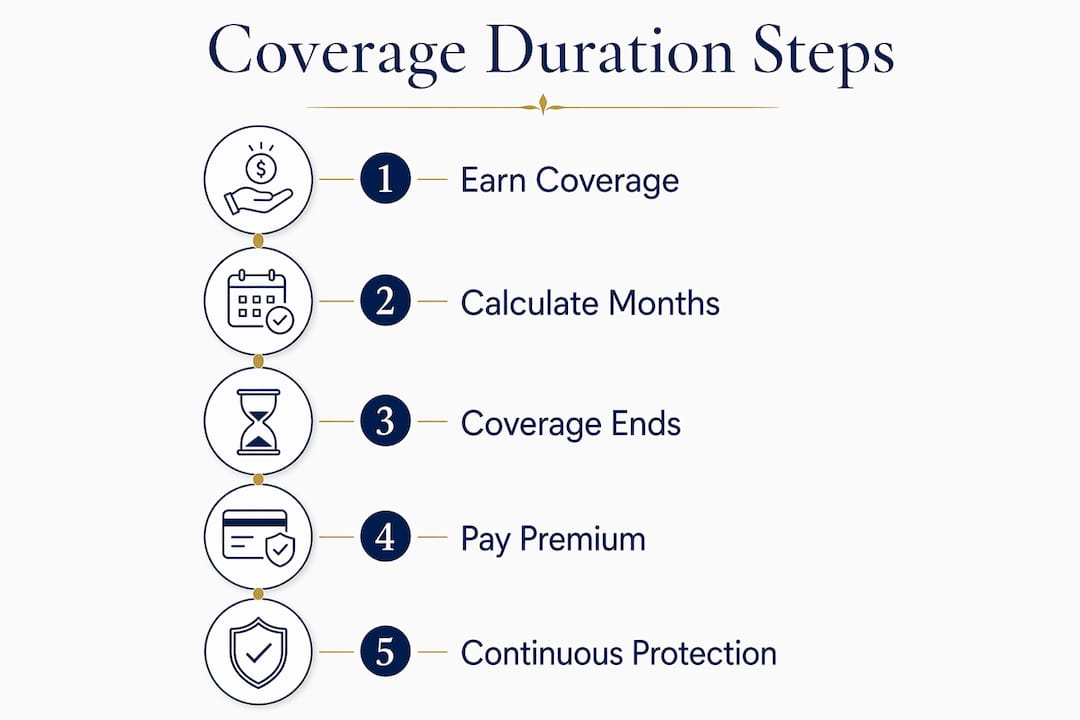
Members earn five months of coverage per credited service year, including qualifying DROP years. The table below reflects the official PSPRS coverage estimates revised in January 2026.
| Years of Service | Months of Coverage | Years and Months of Coverage |
|---|---|---|
| 20 | 100 | 8 years, 4 months |
| 22 | 110 | 9 years, 2 months |
| 24 | 120 | 10 years |
| 25 | 125 | 10 years, 5 months |
| 27 | 135 | 11 years, 3 months |
| 30 | 150 | 12 years, 6 months |
Once the earned period ends, eligible retirees can continue coverage by paying the annual premium of $185. The election deadline for retirees whose free coverage expired before 2026 is january 1, 2027. Miss that window and the option is gone permanently. Retirees whose coverage expires during 2026 have until january 1, 2027, or within the timeframe of their invoice, whichever applies.
Retirees with a prior cancer diagnosis claim face a different path. They have a one-time option to elect continued coverage at the standard premium rate. Declining that option removes all future eligibility, with no exceptions.
HIPAA compliance and your privacy rights as a beneficiary
Every cancer insurance claim involves sensitive personal health information, and the program operates under federal privacy law.
- HIPAA governs all claims data: The Health Insurance Portability and Accountability Act applies to the handling of your medical information throughout the claims process. Program administrators are legally required to protect the confidentiality and security of your health records.
- Your rights as a member or retiree: Under HIPAA regulations, you have the right to know how your information is used, to request access to your records, and to report violations if you believe your privacy has been compromised.
- Controlled information sharing: Your diagnosis and treatment records are shared only as necessary to process your claim. Administrators cannot disclose your personal health information to unauthorized parties, including your employer, without your consent.
- Secure storage and handling: Program administrators are required to maintain physical and electronic safeguards for all stored health data. This includes encryption standards and access controls for digital records.
- Claim submission without fear: HIPAA protections exist precisely so that retirees do not hesitate to file claims out of concern that sensitive health information will be misused. The law creates enforceable accountability for anyone who handles your data.
Managing cancer insurance costs and planning ahead for retirement
The financial risk of a cancer diagnosis in retirement is not just about treatment bills. It is about whether your coverage holds when you need it most.
- Employer retiree health coverage is not guaranteed: Only about 24% of large firms extend healthcare coverage to retirees. Public safety retirees who rely on their PSPRS cancer insurance as their primary cancer coverage plan need to track exactly when their no-cost period ends.
- Budget for the pre-Medicare gap: Most public safety retirees leave service well before age 65. That gap between retirement and Medicare eligibility is when cancer treatment costs hit hardest, with no employer group plan and no Medicare to absorb them.
- Track your enrollment deadlines precisely: Missing the january 1, 2027, election deadline for continued coverage is not a recoverable mistake. Set calendar reminders at least 90 days before any premium or enrollment deadline.
- Understand the refund trap: The 180-day refund option sounds like a safety net, but requesting it ends your coverage and all future eligibility. Do not treat it as a trial period.
- Maintain records of your claim history: If you have previously received a cancer diagnosis claim payment, your eligibility for continued coverage depends on a one-time election. Know where you stand before the deadline arrives.
- Plan for premium continuity: The $185 annual premium is modest relative to cancer treatment costs, but it must be paid consistently. Automatic pension deductions beginning in 2027 reduce the risk of accidental lapse, but only for retirees who have already elected continued coverage.
Pro Tip: Work with a financial advisor who specializes in retirement health planning to map out your total healthcare cost exposure from retirement through Medicare eligibility. Cancer insurance covers a specific slice of that exposure; the rest needs its own plan.

Key Takeaways
The PSPRS Cancer Insurance Program gives public safety and corrections retirees a structured, no-cost cancer coverage benefit earned through active service, with paid extension options that require proactive enrollment management to keep intact.
| Point | Details |
|---|---|
| Coverage earned per service year | Five months of no-cost cancer insurance per credited year, including qualifying DROP service after August 2019. |
| Coverage duration for long-serving members | 30 years of service earns 150 months (12 years, 6 months) of no-cost retirement coverage. |
| Premiums for extended coverage | The annual premium for extended coverage is set and pro-rated amounts may apply for partial-year coverage periods. |
| Benefits structure | Coverage pays lump-sum diagnosis benefits and reimburses out-of-pocket treatment expenses including chemotherapy and radiation. |
| Familyguardlh's role | Familyguardlh helps public safety and corrections retirees build supplemental retirement income and insurance strategies that work alongside PSPRS cancer coverage. |
What most retirees get wrong about cancer coverage in retirement
The conventional wisdom says: earn your years, collect your benefit, and let the program run. That framing misses the single biggest risk in this coverage structure.
The no-cost period is finite and the clock starts the day you retire, not the day you get sick. A 25-year retiree has 10 years and 5 months of free coverage. If they retire at 52, that coverage runs out at roughly 62. Medicare does not begin until 65. That is a three-year window with no employer coverage, no Medicare, and no cancer insurance unless the retiree has actively elected to pay premiums before the deadline. For example, a member with 20 years of credited service earns 100 months (8 years, 4 months) of no-cost coverage, and one with 30 years earns 150 months (12 years, 6 months).
Most people do not think about that gap until they are in it. By then, the election window may have closed.
The other piece that gets overlooked is the claim history rule. Retirees who have already received a cancer diagnosis payment face a one-time, permanent election. There is no second chance, no appeals process for a missed deadline, and no reinstatement without paying all past premiums first. That is a high-stakes decision that deserves the same attention as any major financial choice in retirement.
Financial experts consistently advise budgeting explicitly for healthcare costs that bridge retirement and Medicare eligibility. Cancer insurance is one piece of that budget, but it only works if it is still active when you need it. Proactive enrollment management, not passive reliance on the program, is what separates retirees who are protected from those who discover the gap too late.
Cancer coverage in retirement is not a set-it-and-forget-it benefit. Treat it like the financial asset it is.
Familyguardlh helps public safety retirees protect what they've earned
Public safety and corrections retirees face a coverage window that most retirement planning tools are not built to address. Your PSPRS cancer insurance covers a defined period. What comes after that period, and what sits alongside it, requires a separate strategy.

Familyguardlh specializes in retirement income protection and supplemental insurance for retirees in Arizona, Colorado, Florida, Georgia, and 18 other states. The agency works with public safety and corrections personnel to identify gaps between earned cancer coverage, Medicare eligibility, and long-term care exposure, then builds plans around those gaps using health, life, and supplemental policies. No guesswork about what your PSPRS benefit does and does not cover. Just a clear picture of your retirement health exposure and the options available to fill it.
Explore personalized retirement income strategies with Familyguardlh and find out exactly where your coverage stands.