

If you retire at or near 62, your realistic coverage options are COBRA, an ACA Marketplace plan through a Special Enrollment Period (SEP) with possible premium tax credits, joining a spouse's employer plan, short-term or private plans for very brief gaps, and Medicaid if your income qualifies. Medicare doesn't start at 65 — claiming Social Security at 62 does not trigger it early — so you're looking at up to three years of coverage to arrange on your own.
Here's when each option tends to make the most sense:
- COBRA: Best if you need immediate retroactive protection or have ongoing treatment you can't interrupt. Expensive, but no underwriting and identical benefits.
- ACA Marketplace + SEP: Usually the most cost-effective multi-month option, especially if your post-retirement income drops enough to qualify for premium tax credits.
- Spouse's employer plan: Often the cheapest route if it's available. Losing your coverage triggers a 60-day window to be added.
- Short-term plans: Only for healthy people facing a gap of a few weeks when Marketplace timing doesn't line up. Not for chronic conditions.
- Medicaid: Free or near-free if your projected income falls within your state's threshold. Available year-round.
Your immediate action: Confirm the exact date your employer coverage ends, then mark two deadlines on your calendar: 60 days for COBRA election and 60 days for your Marketplace SEP. Missing either window can leave you uninsured.
Pro Tip: Don't let coverage lapse even for a single day. Both the COBRA election window and the Marketplace SEP run 60 days from the date you lose coverage. If you miss them, you'll wait until the next Open Enrollment period — typically starting November 1 — for Marketplace coverage, and COBRA won't be available at all.
Table of Contents
- How does COBRA work, and what will it actually cost you?
- How do ACA Marketplace plans and Special Enrollment Periods work for early retirees?
- Can you join your spouse's employer plan when you retire?
- What can short-term and private health plans actually cover?
- When does Medicaid cover you, and how do you check?
- Does your employer offer retiree health benefits, and how do they affect your options?
- How do you estimate costs and plan your income to maximize subsidies?
- What's the enrollment timeline to avoid any coverage gap?
- How do you choose the right bridge option for your situation?
- How can an independent broker help you execute this plan?
- Key Takeaways
- What most people get wrong about retiring at 62 without coverage
- Familyguardlh: coverage guidance built for early retirees
- Authoritative sources and further reading
How does COBRA work, and what will it actually cost you?
COBRA lets you continue your employer's health plan after you leave — same network, same benefits, same doctors. The catch is that you now pay the full premium your employer was paying, plus an administrative fee of up to 2%.
Key COBRA facts:
- You have 60 days from losing coverage (or receiving the COBRA notice, whichever is later) to elect it.
- Election is retroactive to the day your employer coverage ended, so you can wait out the window, and if nothing goes wrong, skip it. If something does go wrong, elect it and your coverage backdates.
- Typical duration is up to 18 months for job loss or retirement. Some qualifying events (disability, divorce, death of the covered employee) can extend it further.
- You pay the full group premium. If your employer was covering $600 of a $700/month premium, your COBRA bill is $714/month (the full $700 plus the 2% admin fee).
That cost is the central problem. COBRA is rarely the cheapest option for a multi-year gap, but it has two genuine advantages: no medical underwriting and zero disruption to ongoing care. If you're mid-treatment or have a specialist relationship you can't afford to lose, COBRA buys you time to shop without interrupting care.
One important nuance from CMS: COBRA does not count as creditable group coverage for purposes of delaying Medicare Part B enrollment. If you're approaching 65 while on COBRA, you still need to enroll in Medicare during your Initial Enrollment Period to avoid a late-enrollment penalty.
Pro Tip: Don't auto-elect COBRA the day you retire. Run Marketplace quotes first. If a subsidized Silver plan costs significantly less, you can let the 60-day window run while you shop — and only elect COBRA retroactively if you have a medical emergency during that window. That's the strategy, not the default.
How do ACA Marketplace plans and Special Enrollment Periods work for early retirees?
For most people retiring around 62, the Marketplace is the most practical long-term solution. Losing job-based coverage is a qualifying life event that triggers a 60-day SEP, and you can actually enroll up to 60 days before your coverage ends — meaning you can have a Marketplace plan ready to start the day your employer coverage stops.
Step-by-step enrollment checklist
- Create or log into your account — at HealthCare.gov (or your state exchange if you're in California, New York, or another state-based marketplace).
What determines your subsidy?
Premium tax credits are calculated based on your projected household Modified Adjusted Gross Income (MAGI) and the cost of the benchmark Silver plan in your area. Household size matters too — a couple has a higher income threshold for subsidies than a single person at the same income level.
The income items that count toward MAGI include wages, taxable Social Security benefits, retirement account distributions, pension income, and Roth conversion amounts. If you retire mid-year, your MAGI for that year may still be high because of months you were working. The following year, when you're fully retired, your MAGI often drops substantially — and your subsidy eligibility improves.
State exchanges and HealthCare.gov offer the same ACA plans and the same federal subsidies. The difference is the interface and local customer support. Open Enrollment runs November 1 through January 15 in most states; outside that window, you rely on your SEP.
Pro Tip: Model your MAGI as if you were retired for the full year, not based on your last W-2. If you retired in July, your actual coverage-year income may be half what you earned the year before. That projection is what the Marketplace uses to calculate your credit — and getting it right can mean hundreds of dollars per month in savings. Avoid large Roth conversions in the same year you're claiming subsidies unless you've modeled the impact first.
Can you join your spouse's employer plan when you retire?
Yes, and this is often the simplest and least expensive path if it's available. Losing your own coverage is a qualifying life event that gives your spouse's employer plan a 30-to-60-day window (the exact window depends on the employer's plan rules, so confirm with HR immediately) to add you as a dependent.
Documents you'll typically need:
- Proof of loss of coverage (a letter from your employer or insurer stating your coverage end date)
- Marriage certificate or domestic partner documentation
- Social Security numbers for both spouses
- Completed enrollment forms from the spouse's HR department
A few things to verify before assuming this is your best option:
- Network: Does the plan cover your doctors and specialists?
- Prescriptions: Are your medications on the formulary, and at what tier?
- Cost sharing: What are the deductibles, copays, and out-of-pocket maximums for a two-person plan versus a single plan?
- Domestic partner rules: Some employers limit or exclude domestic partner coverage, or require proof of financial interdependence.
The timing piece is critical. Don't assume the spouse's HR department will automatically know to add you. Contact them the same week you confirm your retirement date, ask for the plan's SEP rules in writing, and submit paperwork before the deadline. A missed employer SEP window means waiting until the spouse's next Open Enrollment.
What can short-term and private health plans actually cover?
Short-term plans are exactly what the name suggests: stopgaps. They can cost $100–$250 per month for a healthy buyer, which sounds attractive compared to COBRA. The tradeoff is significant.
What short-term plans typically exclude or limit:
- Preexisting conditions (often excluded entirely or subject to waiting periods)
- Prescription drug coverage (limited or absent)
- Mental health and substance use treatment
- Maternity care
- Preventive care at no cost
- Annual and lifetime benefit caps that ACA plans prohibit
Some states — including New York, California, and Massachusetts — restrict or ban short-term plans outright. Even where they're allowed, they don't meet ACA minimum essential coverage standards, so a gap on a short-term plan still counts as a coverage gap for subsidy reconciliation purposes.
The risk for someone retiring at 62 is real. If you have a chronic condition, take regular medications, or have any ongoing specialist care, a short-term plan can deny claims for those conditions and leave you with substantial out-of-pocket bills. A surprise hospitalization on a short-term plan can cost far more than the premium savings.

When short-term plans make sense: You're healthy, you have a gap of four to six weeks because your Marketplace plan starts the first of the following month, and you've read the exclusions carefully. That's the narrow use case.
Pro Tip: Before buying any short-term plan, read the exclusions section — not the summary, the actual policy language. Look specifically for "preexisting condition" definitions, which can include conditions you were treated for in the past two to five years. If you take any prescription medication regularly, verify it's covered before you sign.
When does Medicaid cover you, and how do you check?
Medicaid is available year-round with no enrollment window, and for early retirees whose income drops significantly, it can be free or nearly free. The catch is that eligibility is completely state-specific.
In states that expanded Medicaid under the ACA, a single adult generally qualifies if their MAGI is at or below 138% of the Federal Poverty Level. In non-expansion states, the thresholds are much lower and often exclude adults without dependents. Your state's rules are what matter.
How to check your eligibility quickly:
- Visit HealthCare.gov and use the eligibility screener — it will route you to your state Medicaid program if you appear to qualify.
- Go directly to your state's Medicaid agency website for the most current income thresholds and application portal.
- Have your most recent tax return and an estimate of your projected retirement income ready before you apply.
Medicaid applications are processed on a rolling basis, so there's no waiting for an enrollment window. If you qualify, coverage can begin quickly — sometimes the same month you apply. The income figure that matters is your projected MAGI for the current year, not last year's earnings.
One planning note: if your income is just above the Medicaid threshold, you may qualify for substantial Marketplace subsidies instead. The two programs form a continuum, and HealthCare.gov's screener helps you find where you land.
Does your employer offer retiree health benefits, and how do they affect your options?
Employer-sponsored retiree health benefits are uncommon. According to Vanguard's analysis of early retirement planning, only a minority of large employers offer them, and the trend has been declining for years. If yours does, the coverage can be valuable — but it comes with a subsidy trade-off.
If you enroll in your employer's retiree health plan, you generally cannot claim Marketplace premium tax credits for that same coverage period. The IRS considers you covered by employer-sponsored insurance, which disqualifies you from subsidies.
Questions to ask HR before you decide:
- Who is covered — just you, or your spouse and dependents?
- What is the monthly premium, and does the employer contribute?
- Is enrollment required to preserve future eligibility, or can you opt in later?
- How does the plan coordinate with Medicare when you turn 65?
- Does declining retiree coverage now affect your right to enroll later?
There's an important nuance here: if you are eligible for retiree coverage but choose not to enroll, you may still qualify for Marketplace subsidies — depending on whether the retiree plan meets ACA affordability standards. However, if you enroll and then voluntarily drop retiree coverage, you likely won't trigger a Marketplace SEP. That means you could end up without coverage and without a way to enroll until the next Open Enrollment.
Comparing retiree plan vs. Marketplace: a practical checklist
- Get the full premium cost for the retiree plan (your share and total).
- Run a Marketplace quote using your projected retirement MAGI.
- Compare deductibles, copays, out-of-pocket maximums, and prescription formularies side by side.
- Factor in the subsidy you'd forfeit by enrolling in the retiree plan.
- Ask HR whether declining now closes the door permanently.
How do you estimate costs and plan your income to maximize subsidies?
The single most important number in your bridge planning is your projected MAGI for the coverage year. That figure determines your ACA premium tax credits now and will affect your Medicare IRMAA surcharges later through a two-year lookback. Advisors consistently stress modeling this number carefully — small decisions about timing Roth conversions or retirement distributions can meaningfully change what you pay for coverage.
Here's a simplified cost comparison to illustrate the range:
| Bridge Option | Estimated Monthly Premium | Typical Deductible | Notes |
|---|---|---|---|
| COBRA (full premium) | $600–$700 | Same as employer plan | No underwriting; retroactive election available |
| ACA Silver plan (subsidized) | Varies based on income and location; often significantly less than COBRA if MAGI qualifies for premium tax credits | Varies by plan; typically higher than Medicaid, lower than COBRA | Depends heavily on MAGI and location |
| Short-term plan | $100–$250 | — | Preexisting conditions often excluded |
| Medicaid (if eligible) | $0–minimal | Low or none | State-specific income thresholds apply |
Premium estimates are illustrative ranges based on available market data and vary significantly by age, location, and plan selection.
Income items that count toward MAGI:
- Wages and self-employment income
- Taxable Social Security benefits
- Traditional IRA and 401(k) distributions
- Pension income
- Roth conversion amounts (the converted amount is added to MAGI)
- Capital gains and dividends
- Rental income
What does not count: Roth IRA withdrawals of contributions (not earnings), HSA distributions for qualified medical expenses, and life insurance proceeds.
The IRMAA lookback uses your income from two years prior. So if you retire in 2026, your 2026 MAGI affects your 2028 Medicare Part B and Part D premiums. A large Roth conversion in 2026 that pushes your MAGI above an IRMAA threshold could cost you hundreds of dollars per month in Medicare surcharges starting in 2028. If a life-changing event (like retirement) drops your income, you can file SSA Form SSA-44 to request a reduction in IRMAA based on your current income rather than the lookback year.
Pro Tip: Think of MAGI management as a multi-year project, not a single-year decision. The year you retire, the year before Medicare starts, and the first year of Medicare all have different income implications. A financial plan that coordinates Roth conversions, distribution timing, and Social Security claiming with your coverage years can save thousands in premiums across the bridge period. Early retirement budgeting resources like this guide for retiring early on a budget can help you frame the full cost picture.
What's the enrollment timeline to avoid any coverage gap?
Mark your employer coverage end date in red. Everything else flows from that date.
How do you choose the right bridge option for your situation?
The right choice depends on four variables: how long your gap is, what your projected MAGI looks like, what ongoing medical needs you have, and whether a spouse's plan is available.
Decision framework:
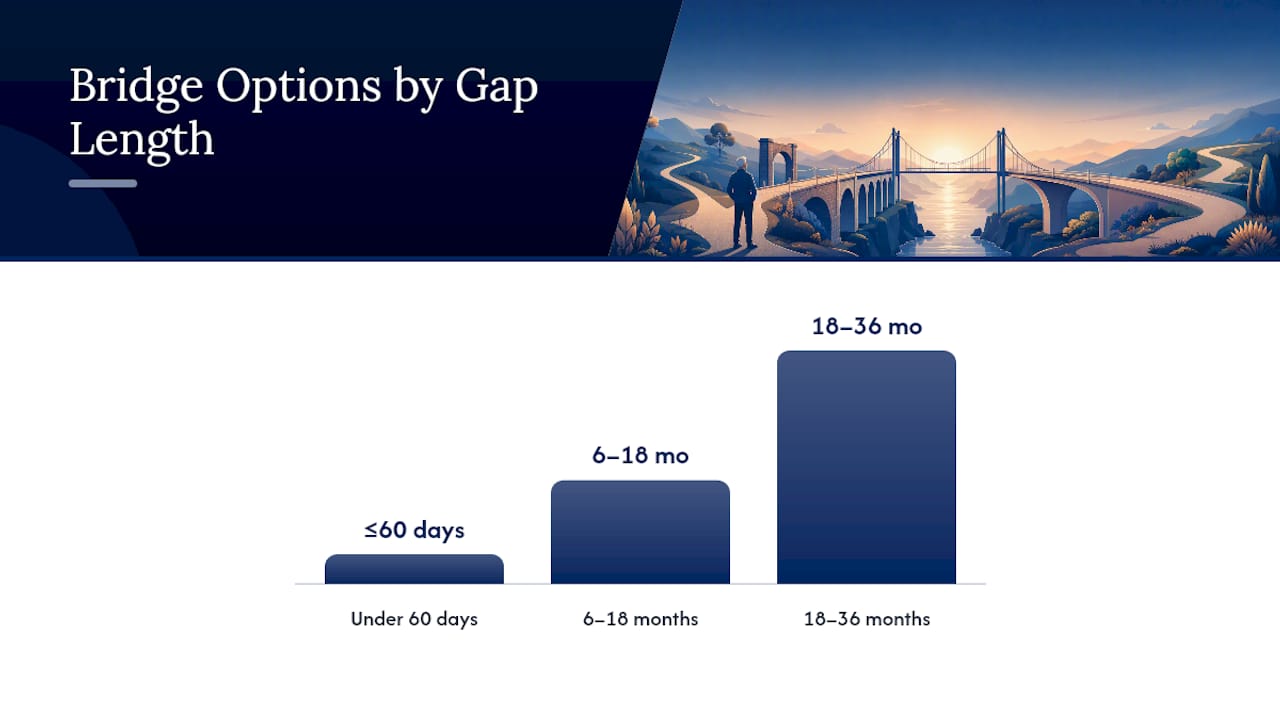
- Gap length: A gap under 60 days may be manageable with COBRA's retroactive election as a safety net. A gap of 6–36 months almost always points to the Marketplace or a spouse's plan.
- Budget: If your MAGI qualifies for substantial subsidies, a Marketplace Silver plan is likely cheapest. If your income is high post-retirement, COBRA or a retiree plan may be comparable.
- Prescriptions and ongoing care: COBRA preserves your exact formulary and network. Marketplace plans vary — verify your medications and doctors before enrolling.
- Underwriting risk: If you have preexisting conditions, avoid short-term plans. ACA Marketplace plans and COBRA cannot deny coverage or charge more based on health status.
- Spouse coverage: Always check this first. It's often the cheapest and simplest option.
| Gap Length | Recommended Option | Key Trade-off |
|---|---|---|
| Under 60 days | COBRA retroactive safety net or short-term plan (healthy only) | Cost vs. retroactive protection |
| 6–18 months | ACA Marketplace with SEP + subsidies | MAGI projection accuracy matters |
| 18–36 months | ACA Marketplace (multi-year) or spouse's plan | Annual re-enrollment and income changes |
| Any length | Spouse's employer plan (if available) | Network and cost-sharing verification required |
Red flags that often backfire:
- Relying on a short-term plan when you have any chronic condition or take regular prescriptions
- Estimating MAGI based on last year's W-2 instead of projected retirement income
- Missing the 60-day SEP window because you assumed COBRA would be automatic
- Enrolling in retiree coverage without checking whether it disqualifies you from Marketplace subsidies
- Forgetting to enroll in Medicare Part B during your IEP because you assumed COBRA covered the transition
For a broader view of how health coverage fits into your overall early retirement financial picture, financial planning for families offers useful context on managing household income and expenses across the pre-Medicare years.
How can an independent broker help you execute this plan?
An independent broker does the comparison work you'd otherwise have to do yourself: running parallel quotes across Marketplace plans, checking whether your COBRA cost beats a subsidized plan, modeling your MAGI to estimate subsidy size, and calendaring every enrollment deadline so nothing slips.
Familyguardlh is licensed in 22 states — AZ, CO, FL, GA, IA, IN, MA, MD, ME, MI, MS, MT, NC, NV, OH, OK, PA, SC, TN, TX, VA, and WA — and works specifically with people navigating the pre-Medicare coverage gap. The services available through a consultation include:
- Marketplace plan enrollment assistance and SEP verification
- MAGI modeling for the coverage year and adjacent years
- COBRA timing review (when to elect, when to skip)
- Spouse plan coordination and document checklist
- Medicare transition planning as you approach 65
- Multi-state licensing for clients who split time between states
A 30-minute consult typically covers your coverage end date, estimated retirement income, current medications and providers, and family coverage status. Bring your most recent tax return, a list of your prescriptions, and your employer's coverage end date letter.
Pro Tip: Bring a list of your five most-used doctors and your top three prescriptions to any broker consultation. The broker can cross-reference those against plan formularies and networks in real time, which saves you from enrolling in a plan that doesn't cover what you actually need.
Key Takeaways
Retiring at 62 means arranging up to three years of health coverage on your own — and the options you choose, and when you choose them, determine both your monthly costs and your Medicare costs years from now.
| Point | Details |
|---|---|
| 60-day SEP and COBRA window | Both run 60 days from your coverage end date; you can start Marketplace enrollment up to 60 days before coverage ends. |
| COBRA lasts up to 18 months | Full premium plus up to 2% admin fee; valuable for retroactive protection and care continuity, rarely the cheapest long-term option. |
| Model your retirement MAGI | Projected income for the coverage year determines ACA subsidies now and Medicare IRMAA surcharges two years later. |
| Spouse's plan and Medicaid | Check spouse's employer plan first; check Medicaid eligibility if income drops significantly — both can be lower cost than Marketplace. |
| Familyguardlh | Licensed in 22 states, Familyguardlh runs parallel quotes, checks subsidy math, and manages enrollment deadlines for early retirees. |
Your 1-3-30 day action plan
Today:
- Confirm your exact employer coverage end date in writing.
- Mark your 60-day COBRA and SEP deadlines on your calendar.
Within 3 days:
- Log into HealthCare.gov and run a Marketplace quote using your projected retirement MAGI.
- Contact your spouse's HR department if a spouse's plan is a possibility.
- Check your state Medicaid portal if your income may fall below the threshold.
Within 30 days:
- Compare Marketplace plan options against COBRA cost (full premium + 2%).
- Enroll in your chosen plan before the 15th of the month for coverage starting the 1st of the following month.
- Schedule a consultation with Familyguardlh to review your MAGI projection, subsidy eligibility, and Medicare transition timeline.
What most people get wrong about retiring at 62 without coverage
The conventional advice is to "compare your options and pick the cheapest one." That framing misses the actual complexity. The cheapest option in month one is rarely the cheapest option across three years, and the income decisions you make in the first year of retirement ripple forward into Medicare costs two years later.
Most people underestimate how much MAGI management matters. A retiree who takes a large IRA distribution in their first retirement year to cover expenses can inadvertently push their income above the subsidy cliff, paying full Marketplace premiums instead of subsidized ones. The same distribution, spread across two years, might preserve subsidy eligibility both years. That's not a minor detail — it can mean a difference of several thousand dollars annually.
Short-term plans are the other common mistake. They look affordable until you actually need them. The people who end up in financial trouble from short-term plans are almost never the ones who read the exclusions carefully. They're the ones who assumed "health insurance" meant comprehensive coverage, then discovered their plan excluded the condition that sent them to the hospital.
The 60-day SEP window is genuinely unforgiving. Miss it, and you're waiting for Open Enrollment in November — potentially months without coverage. The retroactive COBRA election is a useful safety net, but it only works if you haven't already let the window close.
What actually works is treating the bridge period as a financial planning problem, not just an insurance shopping problem. That means projecting income across multiple years, coordinating Roth conversions with subsidy eligibility, and building a timeline that accounts for Medicare enrollment before you turn 65. The AdvisorGuide bridge planning checklist is one of the more thorough resources for working through that multi-year picture.
Familyguardlh: coverage guidance built for early retirees
Sorting through COBRA costs, Marketplace subsidies, and Medicare timing on your own is genuinely complicated — and the stakes are high enough that a wrong call can cost thousands. Familyguardlh offers something specific: an independent broker who runs the numbers across all your options, checks your subsidy eligibility against your actual projected income, and keeps your enrollment calendar on track so no deadline slips.

Licensed across 22 states — AZ, CO, FL, GA, IA, IN, MA, MD, ME, MI, MS, MT, NC, NV, OH, OK, PA, SC, TN, TX, VA, and WA — Familyguardlh works with early retirees who need more than a quote comparison. A consultation covers your coverage end date, MAGI projection, prescription and provider needs, and the Medicare transition plan you'll need before you turn 65.
To get started, visit Familyguardlh and schedule a 30-minute consult. Bring your most recent tax return, your employer's coverage end date letter, and a list of your current medications. The consult is the first step toward knowing exactly what you'll pay, when coverage starts, and what to do when Medicare becomes available.
Authoritative sources and further reading
- Health coverage for retirees
- How to cancel a Marketplace plan
- COBRA — U.S. Department of Labor
- COBRA fact sheet — CMS
- HealthCare.gov
- Early retirement: Bridging the gap until Medicare — Vanguard
- Health insurance gap planning: COBRA, ACA, and the bridge to Medicare — AdvisorGuide
- Health insurance gap between jobs: how to cover it — InsuranceClarify
- Social Security retirement planner — SSA