

A surrender charge is the fee an insurance company deducts when you withdraw more than your contract allows during the surrender period, and it can eat a real chunk of your money fast. Pull $100,000 out of an annuity in year one of a typical schedule, and a 7% surrender charge means you lose $7,000 before taxes even enter the picture.
Here's the quick read on when this matters:
- You need cash now: check your free-withdrawal allowance before you touch anything else.
- You're comparing annuities: ask for the exact surrender schedule in writing, not a verbal summary.
- You're past year seven or eight: the charge may already be low enough that waiting a few more months solves the problem.
Key Takeaways
Surrender charges are declining, time-limited fees that shrink an early annuity withdrawal by a set percentage until the surrender period ends.
| Point | Details |
|---|---|
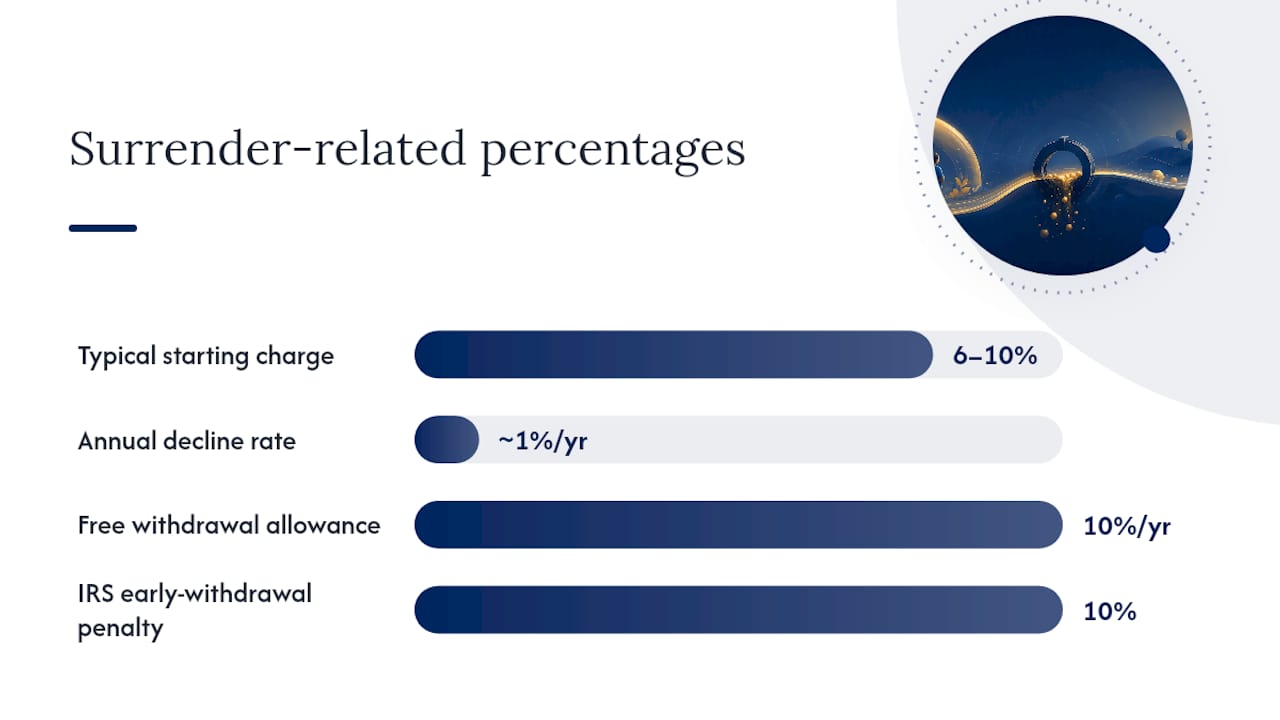
| Surrender charges decline over time | Most schedules start at 6%–10% and drop roughly 1 point per year until they hit zero. |
| Taxes stack on top | Gains are taxed as ordinary income, and a 10% IRS penalty often applies before age 59½. |
| Free withdrawals exist | Many contracts allow about 10% of account value out each year with no surrender charge. |
| SECURE Act helps workplace annuities | Portability rules can let some employer-plan annuities transfer without triggering a fee. |
| Get advisor guidance before acting | Family Guard Life & Health, licensed in 22 states, helps retirement savers request surrender-cost illustrations and compare options. |
Table of Contents
- How Annuity Surrender Charges Are Calculated
- Why Insurers Charge a Fee for Early Withdrawals
- Annuity Fees Explained: The Terms You'll See in Your Contract
- Typical Surrender Charge Amounts and Schedules
- Early Withdrawal Penalties and Tax Consequences
- How to Avoid or Minimize Surrender Charges
- Questions to Ask Before You Buy or Surrender
- SECURE Act Portability and Surrender Fees
- Planning Your Next Move With Family Guard Life & Health
- Frequently Asked Questions
- Sources
How Annuity Surrender Charges Are Calculated
Insurers structure these fees as a declining percentage tied to a set number of years, often called a contingent deferred sales charge, or CDSC.
Say you have a 7-year schedule starting at 7%. Wait until year eight, and the charge is gone entirely.
Pro Tip: If you've added money to your annuity through multiple premium payments, each deposit can start its own surrender clock. That means part of your account might be penalty-free while another chunk is still deep in year one.
Why Insurers Charge a Fee for Early Withdrawals
Insurance companies aren't padding profits arbitrarily. They front significant sales and administrative costs when you buy a contract, and they need time to recoup that investment while putting your premium to work in longer-term assets.
That long-term investment strategy is also what lets carriers offer the guaranteed rates that make annuities attractive in the first place. Surrender charges discourage the early exits that would force insurers to sell those assets at a bad time, which supports the guaranteed-rate structure the whole product depends on.
- Recovering commission and setup costs paid at issue
- Protecting long-duration investment portfolios from forced liquidation
- Managing overall risk across the insurer's book of contracts
Annuity Fees Explained: The Terms You'll See in Your Contract
A handful of terms show up in nearly every annuity disclosure, and knowing them changes how you read your statement.
- CDSC (contingent deferred sales charge): the formal name for a surrender fee, "contingent" because it only applies if you withdraw early.
- Market Value Adjustment (MVA): a separate adjustment, positive or negative, tied to interest rate movement since you bought the contract. If rates rose since purchase, an MVA can increase your effective penalty; if they fell, it can soften it.
- Free-withdrawal amount: the annuity free withdrawal amount you can take each year without triggering any charge, commonly around 10% of account value.
- Surrender period: the span of years during which withdrawals above the free amount trigger a fee.
- Waiver riders: provisions that suspend the charge entirely under conditions like nursing home confinement or terminal illness.
Typical Surrender Charge Amounts and Schedules
Surrender charge limits vary by product, but most contracts start somewhere between 6% and 10% in year one and decline over a period of 3 to 10 years, with free withdrawal provisions typically allowing about 10% of account value annually without penalty.
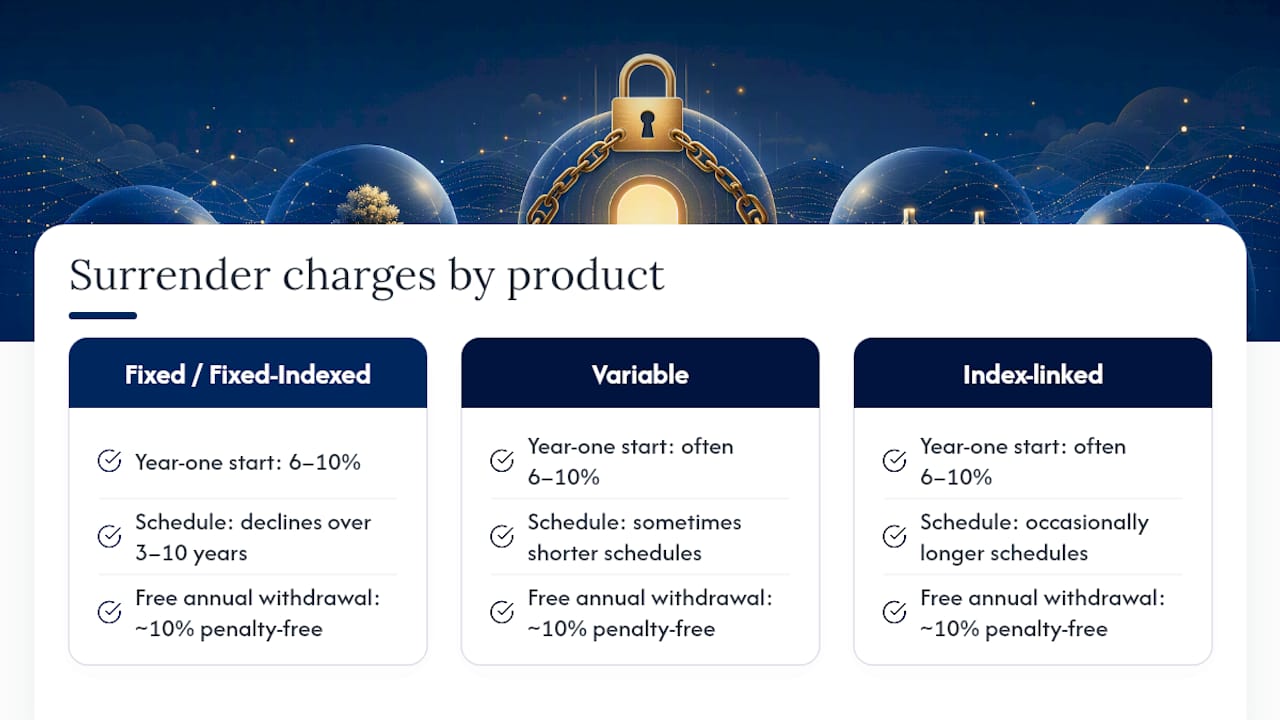
Most fixed and fixed-indexed annuities land in the 6%–10% range in year one, with variable annuities sometimes running shorter schedules and index-linked products occasionally stretching longer. The exact numbers depend entirely on the carrier and product line, so treat any range as a starting point for comparison, not a guarantee.
Early Withdrawal Penalties and Tax Consequences
Surrender charges are only half the cost equation. The IRS treats gains withdrawn from an annuity as ordinary income, and if you're under 59½, a 10% federal early-distribution penalty often applies on top of that, unless a specific exception fits your situation.
That means a poorly timed withdrawal can stack three separate costs: the insurer's surrender charge, ordinary income tax on the gain portion, and the IRS penalty. Understanding annuity costs means understanding all three layers, not just the one your insurer quotes.
- Always request a written tax-cost illustration from your carrier or advisor before surrendering, so you see the surrender charge, taxable gain, and any penalty side by side.
How to Avoid or Minimize Surrender Charges
You have more room to maneuver than most people assume. Here's the order to work through it:
- Estimate the fee. Pull your contract's surrender schedule and calculate what a full or partial withdrawal would cost today.
- Check your free-withdrawal allowance. Many contracts let you take roughly 10% out each year with no charge at all.
- Request a current MVA illustration. Ask the carrier to show you today's adjustment, since it can move your effective cost significantly.
- Compare alternatives. Annuitizing converts the contract into a income stream and often bypasses surrender fees; a 1035 exchange moves funds to a new annuity tax-free but doesn't automatically erase the old contract's surrender charge unless the new carrier agrees to credit it; loans, where available, avoid withdrawal entirely but accrue interest.
- Consult an advisor before finalizing, especially if multiple premium deposits or riders complicate the math.
If your annuity sits inside an employer plan, ask about rollover options too. Readers building a broader liquidity plan often benefit from a structured retirement income bucket strategy that keeps enough cash outside annuities to avoid ever needing an early withdrawal.
Pro Tip: Time withdrawals around your contract anniversary date whenever possible. Surrender percentages typically drop on the anniversary, and MVA exposure can shift with interest rate changes between now and then.
Questions to Ask Before You Buy or Surrender
Bring this list to any conversation with an agent or carrier representative:
- What's the exact surrender schedule, year by year, in writing?
- Is the charge calculated on the full withdrawal or only the amount above the free allowance?
- Does this contract include a Market Value Adjustment, and what's the formula?
- What waiver conditions exist, and what do they require to trigger?
- What's my state's nonforfeiture floor for cash surrender value?
- Are there additional rider fees stacked on top of the surrender charge?
- If I've made multiple premium payments, how are they tracked for surrender purposes?
Red flags worth walking away from: a vague or missing surrender schedule, no free-withdrawal provision at all, or a long surrender period with zero waiver options.
SECURE Act Portability and Surrender Fees
The SECURE Act of 2019 opened a portability path that lets certain workplace annuities move to another employer plan or an IRA without triggering the liquidation that normally causes surrender charges.
This mostly helps people whose annuity lives inside a 401(k)-style plan and who are changing jobs or retiring. It doesn't apply to annuities purchased directly outside a workplace plan.
Pro Tip: Never assume portability applies to your situation. Get written confirmation from your plan administrator before you count on a fee-free transfer.
A note from Family Guard Life & Health
Complex tax questions, layered contracts with multiple premium deposits, or an annuity that's become your only liquid lifeline are exactly when a second set of eyes matters most. Family Guard Life & Health is licensed across 22 states and works directly with retirement savers navigating these decisions.
Planning Your Next Move With Family Guard Life & Health
Family Guard Life & Health builds retirement income plans around the full picture, not just the annuity in isolation. That means weighing your surrender schedule, your tax exposure, and your liquidity needs together, instead of guessing at what a single withdrawal will actually cost you.

If you're staring down a contract and wondering whether now's the right time to withdraw, annuitize, or exchange, the smartest first step is getting a written surrender-cost illustration from your carrier and reviewing it with someone who does this daily. Family Guard Life & Health offers consultations for retirement savers in the 22 states it serves, and can help you work through the math before you make an irreversible move. Check licensure for your state and schedule a consultation to get a clear picture of your specific contract.
Frequently Asked Questions
Can you withdraw from an annuity without paying a fee? Anything beyond that during the surrender period triggers the charge.
How do surrender charges explained in my contract differ from taxes? Surrender charges are insurer fees for early access to your money.
What's the impact of surrender charges on a full annuity surrender? It depends on your contract year and account value.
Does a 1035 exchange eliminate surrender charges? Not automatically. It defers taxes on the transfer, but the original contract's surrender charge still applies unless the new carrier agrees to credit it.
This article is general information, not a substitute for advice from a qualified financial advisor. Consult a qualified financial professional about your own circumstances before acting on anything here.
Sources
- Surrender Charge
- Publication 575 (Pension and Annuity Income)
- What are surrender fees?
- Surrender charge definition and impact | Investopedia