

Annuity income is defined as a guaranteed stream of payments from an insurance carrier, designed to cover essential retirement expenses regardless of what markets do. For anyone nearing or already in retirement, annuity income retirement planning is the process of sizing, selecting, and timing these payments to build a dependable income floor. Social Security and pensions form the foundation of most retirement income plans, but gaps remain for millions of retirees. Annuities fill those gaps with contractual certainty. Unlike a 401(k), annuities carry no IRS contribution limits in 2026, which makes them a flexible tool for converting savings into lifetime income.
How to calculate your retirement income needs
The income gap is the single number that drives every annuity decision you make. Get it right, and you buy exactly what you need. Get it wrong, and you either over-annuitize and lose liquidity, or under-annuitize and face shortfalls.
The income floor calculation focuses only on essential monthly expenses, not discretionary spending. That distinction matters because you only need guaranteed income to cover costs you cannot skip.
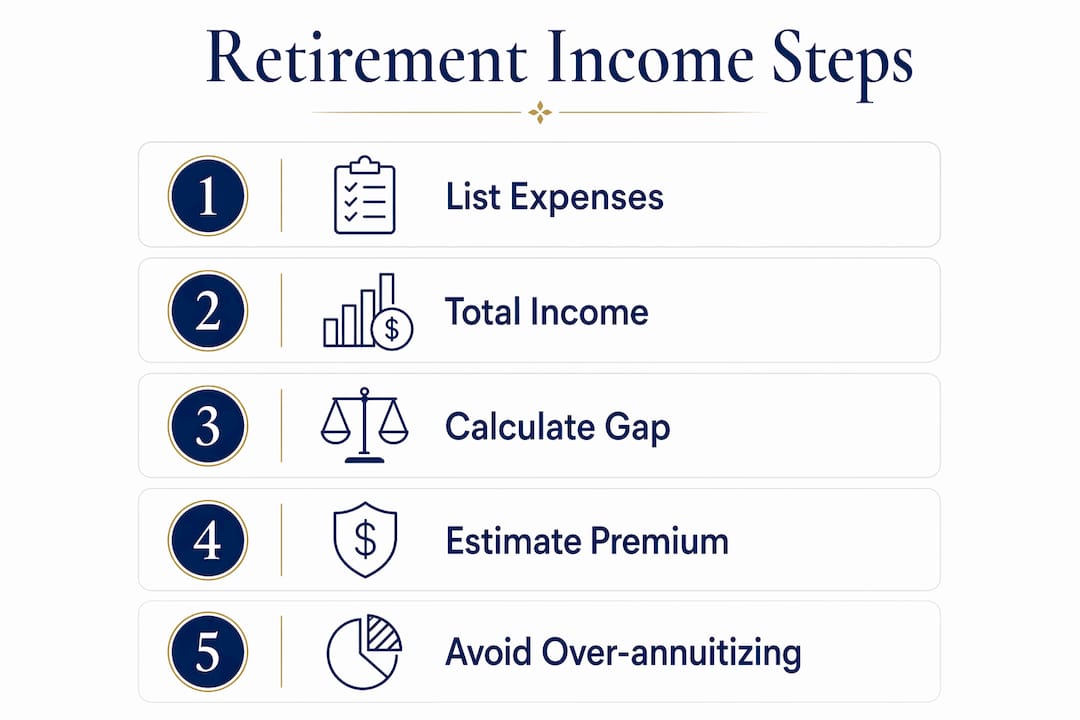
Step 1: List your essential monthly expenses.
Include housing (mortgage or rent, property taxes, insurance), food, utilities, healthcare premiums and out-of-pocket costs, and minimum debt payments. Leave out travel, dining out, and entertainment. Those are discretionary and belong in a separate investment bucket.

Step 2: Total your guaranteed income sources.
Add your expected Social Security benefit and any pension income. If you have not claimed Social Security yet, use your projected benefit at your planned start age.
Step 3: Subtract guaranteed income from essential expenses.
The result is your monthly income gap. If your essential expenses total $4,500 per month and your Social Security pays $2,800, your gap is $1,700 per month.
Step 4: Convert the gap into an annuity premium estimate.
A 70-year-old male can generate roughly $660–$710 per month for every $100,000 placed in a life-only Single Premium Immediate Annuity (SPIA) from an A-rated carrier. That means closing a $1,700 monthly gap requires approximately $240,000–$260,000 in premium. Use this as a starting estimate, then refine it with actual quotes.
Step 5: Confirm you are not over-annuitizing.
Annuitized money is illiquid. Keep enough outside the annuity for emergencies, healthcare surprises, and discretionary spending.
Pro Tip: Get quotes from at least three carriers before committing. Payout rates vary meaningfully across insurers, and a small difference in monthly income compounds significantly over a 20-year retirement.
What are the best annuity types for retirement income?
The right annuity type depends on when you need income, how much flexibility you want, and how long you expect to live. Four product categories cover most retirement income needs.
Single Premium Immediate Annuities (SPIAs) start paying within 30 days of purchase. You hand over a lump sum and receive a fixed monthly check for life or a set period. SPIAs offer the highest payout rates of any annuity type because you give up access to principal entirely. They work best for retirees who need income now and have other liquid assets for emergencies.
Deferred Income Annuities (DIAs) work like SPIAs but with a delayed start date, often 5–15 years out. You pay a premium today and income begins at a future age, such as 80 or 85. DIAs are the most cost-effective tool for longevity protection because the long deferral period dramatically increases the monthly payout.
Fixed Index Annuities (FIAs) with Guaranteed Lifetime Withdrawal Benefit (GLWB) riders credit interest linked to a market index without direct market exposure. The GLWB rider guarantees a minimum annual withdrawal percentage for life, even if the account value drops to zero. These products preserve some access to principal, which SPIAs do not. The trade-off is cost: GLWB rider fees typically run 0.75%–1.25% annually, which reduces the net payout rate.
Variable Annuities with GLWB riders invest in subaccounts similar to mutual funds, offering growth potential alongside a guaranteed income floor. They carry higher fees and more complexity than FIAs, and they suit retirees comfortable with some market exposure who still want a guaranteed minimum income.
| Annuity type | Income start | Liquidity | Best for |
|---|---|---|---|
| SPIA | Immediate | None | Covering income gaps now |
| DIA | Deferred (5–15 years) | None | Longevity protection |
| FIA with GLWB | Flexible | Partial | Flexibility plus guarantee |
| Variable with GLWB | Flexible | Partial | Growth plus income floor |
- SPIAs and DIAs deliver the purest income guarantee with no ongoing fees.
- FIAs and variable annuities with GLWB riders add flexibility but reduce net payout.
- Joint-life payout options reduce monthly income but protect a surviving spouse.
- Inflation-adjusted payout options start lower but grow over time, protecting purchasing power.
Pro Tip: If you are in your early 60s and do not need income yet, a DIA purchased now for income starting at 80 can cost a fraction of what a SPIA would cost at that age. The math strongly favors early purchase for longevity coverage.
How do annuities fit with your other retirement income sources?
Annuities and 401(k)s serve different purposes, and using both creates a balanced plan with secure income and growth potential. A 401(k) accumulates wealth during your working years. An annuity distributes that wealth as guaranteed income during retirement. Treating them as competitors misses the point entirely.
The most practical framework is the income floor and upside bucket approach. Guaranteed income sources, including Social Security, pensions, and annuities, cover essential monthly expenses. Your investment portfolio, held in 401(k)s, IRAs, and taxable accounts, covers discretionary spending, travel, and legacy goals. Immediate annuities paired with Social Security can increase lifetime spending compared to relying on a bond portfolio alone, because annuity payout rates have exceeded 4.9% bond returns in recent research.
Timing matters significantly in this framework:
- Delaying Social Security to age 70 increases your guaranteed benefit by roughly 77% compared to claiming at 62. That higher guaranteed base reduces the annuity premium you need to close your income gap.
- If you retire at 62 but plan to delay Social Security to 70, a SPIA or DIA can bridge the income gap during those eight years without drawing down your investment portfolio prematurely.
- Rolling over a portion of a 401(k) or IRA into an annuity is a tax-neutral event when done correctly as a direct rollover. The annuity then sits inside the IRA wrapper, and distributions are taxed as ordinary income, the same as any IRA withdrawal.
- Annuities purchased outside an IRA with after-tax dollars receive a partial exclusion ratio, meaning a portion of each payment is treated as a return of principal and is not taxed.
The key discipline is keeping your investment portfolio intact for growth and liquidity. Annuitize only the income gap, not your entire savings.
How do you buy an annuity without making costly mistakes?
Buying an annuity is a long-term commitment, and the process rewards patience and comparison.
- Calculate your income gap first. Never start with a product. Start with the number you need to cover.
- Work with an independent agent or advisor. Independent agents access multiple carriers and can compare quotes objectively. Captive agents represent one carrier only.
- Compare at least three carrier quotes. Payout rates differ across insurers. Carriers with the strongest financial ratings may offer slightly lower payouts, but that trade-off is worth it for a 20-to-30-year income commitment.
- Read the surrender charge schedule carefully. Many annuities carry surrender charges of 7%–10% in early years. If you might need the money back, a product with a shorter surrender period or no surrender charge is worth the lower payout.
- Understand rider fees before signing. GLWB riders add guaranteed income but cost 0.75%–1.25% per year. Model the net income after fees, not the gross guarantee.
- Review your annuity strategy annually. Your income needs, health status, and market conditions change. An annuity purchased at 65 may need to be supplemented or adjusted by 75.
Choosing an annuity carrier based solely on the highest payout rate is the most common and most costly mistake retirees make. A carrier that fails in year 15 of a 25-year income commitment leaves you with state guaranty fund coverage, which is capped and varies by state. Financial strength ratings from AM Best, Moody's, or S&P are not optional reading.
Pro Tip: Ask every carrier for their AM Best rating before requesting a quote. Only consider carriers rated A or better for a lifetime income product.
Key Takeaways
Annuity income retirement planning works best when you size your annuity to cover only the essential expense gap that Social Security and pensions cannot fill.
| Point | Details |
|---|---|
| Calculate the income gap first | Subtract guaranteed income from essential expenses to find the exact annuity amount you need. |
| Match annuity type to timing | Use SPIAs for immediate income, DIAs for longevity protection, and GLWB riders for flexibility. |
| Delay Social Security when possible | Claiming at 70 instead of 62 can increase your guaranteed benefit by roughly 77%, reducing annuity cost. |
| Prioritize carrier financial strength | Choose carriers rated A or better by AM Best, even if their payout is slightly lower. |
| Keep investments separate | Annuitize only the income gap. Preserve your portfolio for growth, discretionary spending, and emergencies. |
Why I think most retirees get annuities backward
Most retirees I talk with approach annuities the wrong way. They ask, "Should I buy an annuity?" before they have ever calculated their income gap. That question has no useful answer without the number. The real question is, "How much guaranteed income do I need, and what is the most cost-effective way to get it?"
The annuity industry is shifting toward simpler, more transparent products, which is long overdue. But the behavioral challenge remains. Retirees resist handing over a lump sum because it feels like a loss of control. What they are actually buying is the elimination of the single biggest financial risk in retirement: outliving their money.
The retirees I see with the most peace of mind are not the ones with the largest portfolios. They are the ones whose essential expenses are fully covered by guaranteed income. That security changes how they spend, how they invest, and how they sleep at night. Annuities, used correctly, are not a product. They are a strategy for removing financial fear from retirement.
— Shereka
Retirement income planning with Familyguardlh
Familyguardlh specializes in helping retirees and pre-retirees build guaranteed income strategies using annuities and supplemental insurance products. The team is licensed across 22 states, including FL, TX, GA, NC, and OH, and works with multiple carriers to find the right fit for your income gap and risk tolerance.

Whether you need a SPIA to start income now, a DIA for longevity protection, or a GLWB rider for flexibility, Familyguardlh compares options across carriers so you get the payout and the financial strength your retirement requires. Reach out to the retirement income specialists at Familyguardlh to get a personalized income gap analysis and annuity quotes tailored to your situation.
FAQ
What is annuity income in retirement planning?
Annuity income is a guaranteed payment stream from an insurance carrier, used to cover essential retirement expenses that Social Security and pensions do not fully fund. It forms the income floor in a retirement income plan.
How much does a $100,000 annuity pay per month?
A 70-year-old male investing $100,000 in a life-only SPIA from an A-rated carrier can receive approximately $660–$710 per month in guaranteed income based on early 2026 payout estimates.
Is an annuity better than a 401(k) for retirement income?
Annuities and 401(k)s serve different roles. A 401(k) builds wealth during your working years, while an annuity converts savings into guaranteed lifetime income. Most retirees benefit from using both together.
Can I roll my IRA or 401(k) into an annuity?
Yes. A direct rollover from a 401(k) or IRA into an annuity is a tax-neutral transfer. The annuity sits inside the IRA wrapper, and distributions are taxed as ordinary income when withdrawn.
When is the best time to buy an annuity?
The best time depends on the product type. SPIAs deliver higher payouts when purchased later, around age 70 or older. DIAs benefit from early purchase, since a longer deferral period dramatically increases the future monthly income.